Gen Z Effect: How Companies are Gamifying Rewards
Organizations are now integrating gamification to gain the attention of Gen Z employees, who were born between the late 1990s and early 2010s. This generation
Organizations are now integrating gamification to gain the attention of Gen Z employees, who were born between the late 1990s and early 2010s. This generation has different values and expectations that cannot be compared to other generations.
With the increase of Gen Z in the workplace, organizations are adapting new reward structures to fit the generation. Incorporating game-like elements in the employee reward and recognition programs is a way through which companies are making the work environment more appealing and motivating to Gen Z thus, enhancing employee satisfaction and performance.
Understanding Gen Z Mindset
For reward programs to be effective, it is important to understand what Gen Z wants. They are people born between the late 1990s and early 2010s and are recognized as the most tech-savvy generation. Their upbringing influences their behavior and expectations in the workplace.
Digital Natives
Gen Z is the first generation that grew up with digital technology from a young age. They are familiar with the use of digital platforms and expect smooth and intuitive experiences with the tools and activities they perform at work.
Values and Preferences
Gen Z values authenticity, purpose, and meaningful causes. They seek employers who are ethical, environmentally conscious, and committed to improving society. They appreciate organizations that embrace diversity and make everyone feel included and valued without any discrimination.
Why Is It Important to Reward Gen Z?
Every employee deserves to be rewarded by their company. It doesn’t only make them happy, but it can also boost their performance which initially helps for organizational growth.
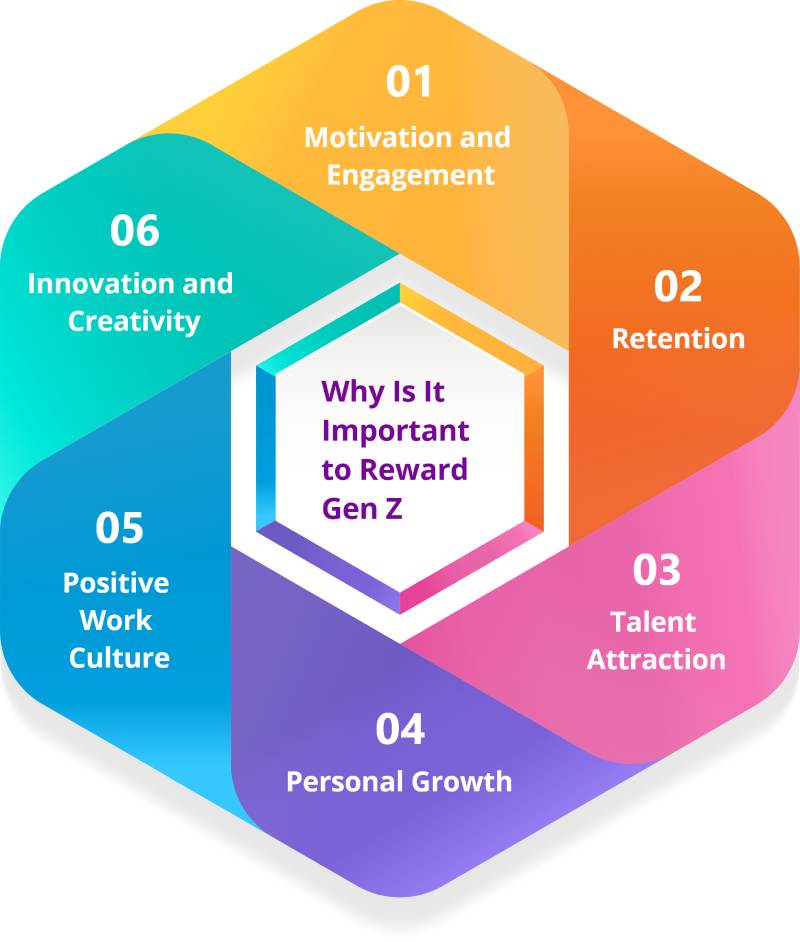
1. Motivation and Engagement
Appreciating employees’ efforts can increase morale. Gen Z, which is the most tech-savvy generation, is used to getting instant results and appreciation. It can improve their dedication and work output.
2. Retention
It is also important to note that Gen Z employees are very particular about work-life balance and the purpose of work. If they are well rewarded and appreciated, they are likely to stay in the company which minimizes turnover and the expenses that are associated with it such as recruitment and training of new employees.
3. Talent Attraction
The reward system can also be a powerful tool to attract talented employees. Gen Z employees expect more than just good pay, they expect a workplace where it can fulfill their requirements.
4. Personal Growth
Gen Z employees appreciate chances to grow as individuals and employees. Recognizing their efforts and achievements not only acknowledges their hard work but also supports their dreams for ongoing development.
4. Positive Work Culture
Rewarding employees can create a good working environment. It contributes to the development of positive behavior towards co-workers, which in turn increases overall satisfaction with the job and the level of cooperation within the team.
5. Innovation and Creativity
Rewarding creativity and innovative thinking can help in capturing the technological and innovative spirit of Gen Z to foster change and development within the organization.
Effectively rewarding Gen Z can lead to better performance and job satisfaction which improves organizational growth.
The Rise of Gamification in Reward Programs
Companies are evolving their methods, and the incorporation of gamification in reward programs is becoming a new trend to enhance the engagement of employees.
Well, who doesn’t like to have some fun at work?
For example, consider a team where employees are rewarded with points for each successful task, and the best performers are given badges and recognition. This trend is especially appealing to Gen Z employees who are digital natives and are motivated by competition and interactivity.
By turning work activities into game-like rewards, employees will be motivated to work harder. It isn’t only for fun it can also promote friendly cooperation among employees.
Furthermore, it is effective in understanding the employees’ preferences and the
outcome of the intervention. Through gamified rewards, engagement and performance can be monitored and the data
collected can improve the reward programs.
For instance, if a company realizes that its employees are inspired
by appreciation and reward systems; then the firm can adjust its incentives to
incorporate such aspects, thus increasing the level of satisfaction in the workplace.
Strategies for Gamifying Rewards
Gamifying rewards can be an effective way to motivate and engage employees. Here are several strategies to effectively gamify rewards:
1. Points and levels
This is a point-based system where employees earn points whenever they finish a task or achieve milestones. As employees gain more points, new levels are introduced thereby unlocking rewards at each level.
2. Leaderboards
Leaderboards show who’s doing the best, which makes employees feel accomplished and motivates them to compete positively.
3. Digital Badges
We know how Gen Z is obsessed with social platforms. They love to share everything on social media. Digital badges, which represent achievements or skill acquisition are increasing among companies. These badges are particularly designed to be shared on social media, allowing employees to showcase their achievements.
The above-mentioned strategies can help organizations to create an engageable and friendly environment.
Success Stories: Companies Excelling in Gamified Rewards
According to the 2019 Gamification at Work survey, 89% of
employees believe that they would be more productive if gamifications were integrated into their work environments.
You may not believe it but it’s true!
In India, many companies started to implement gamified rewards and
excelled. Here are some success stories:
Epsilon India is one of the leading global marketing companies that deals in data marketing technology and services. It has introduced a ‘passport’ called ‘Citizen of Youniverse’ to meet the younger generation’s desire for fun and social media engagement. The passport will get stamped whenever employees participate in any office event.
Isn’t it exciting?
Roche Information Solutions India is researching and developing digital solutions to help deliver medical value on integrated testing solutions. They have an internal marketplace called ‘Applause’, where employees will earn points that can be redeemed to buy anything according to their wishes. It can be a pair of tickets or headphones etc.
Some companies such as Merck India, Thryve Digital, and Allstate India have implemented leaderboards which allows employees to congratulate or thank each other, irrespective of their seniority.
Balasubramanian Sankaranarayanan, President and CEO of Thryve Digital, said, “Young professionals today seek social and emotional connection, and these leaderboards help in achieving this.”
Employees can earn awards in 3 categories at Merck India, such as: Annual appreciation week, panel-based award, and spot awards.
On the other hand, Allstate India gives each employee 100 points per month which can be given to colleagues and redeemed in the company’s internal economy.
The following success stories show how gamification of rewards can improve workplace productivity and motivation. Now, it is your organization’s turn to be among these successful companies that have embraced the use of social media.
Final Thoughts
Gamification can make work more interesting and motivate Gen Z employees. The use of points, leaderboards, and digital badges can help to improve job satisfaction and performance. Thus, your organization can improve the environment of the workplace and make it more satisfying by implementing these strategies.

Jahnavi Pulluri

Table of Content
-
 Understanding Gen Z Mindset
-
Why Is It Important to Reward Gen Z?
-
The Rise of Gamification in Reward Programs
-
Strategies for Gamifying Rewards
-
Success Stories: Companies Excelling in Gamified Rewards
-
Final Thoughts
Related Blogs
Unlock the secrets to evaluating and boosting employee satisfaction. Explore actionable tips and techniques for measuring and enhancing workplace morale.
Tarun Kumar Reddy | 10 July 2024
Explore key types and strategies for employee performance monitoring to boost productivity and align team goals with company success.
Jahnavi Pulluri | 21 January 2025
Transform your performance evaluations with 80+ carefully curated performance appraisal comments, guiding progress and success with precision.
Shabana Shaik | 15 July 2024
Increase workplace efficiency by setting performance standards! Find out how goals enhance productivity and quality.
Jahnavi Pulluri | 10 July 2024
Explore various productivity report templates to enhance your employee performance reviews and streamline evaluations.
Shabana Shaik | 28 June 2024
Want to improve employee performance and retention? A strong performance appraisal system can make all the difference. See how to
Shabana Shaik | 24 June 2024


 4.7/5 avg.
Ready to Manage Your Workforce Smarter?
Join our family of 1500+ companies using smart insights to redefine workforces!

Free Trial
No Credit Card Required