How to Ask for Work From Home: A Step-by-Step Guide
How to ask for work from home in 8 steps: what to say, when to ask, 5 free email templates, and how to answer the visibility question behind most refusals.

Many companies have mandated a return to the office post-pandemic, and Gen Z finds it very inflexible to work only from the office. As flexibility has become a new norm of sophistication in workplaces, people are looking for ways to convince their boss to allow work from home.
In fact, 74% of U.S. companies are using or planning to adopt a permanent hybrid work model, but the market has tightened, and a vague request lands badly in 2026.
This blog tells you 11 effective and clean methods to ask for work from home that your boss stands zero chance of rejecting.
How to Ask for Work from Home?
Asking for work from home is a literal art, one wrong stroke can make it seem like a business proposal rather than a personal request.
Before asking for WFH, check your company’s existing remote work policies and then decide exactly what you are asking for, build the case around what your employer gains, put it in writing, ask in a live conversation, and offer a trial period.
Here are the steps you need to take care of:
| Step | In One Line |
|---|---|
| Check what already exists | Policy, handbook, and who has been granted it before |
| Decide exactly what you are asking for | Two days, permanent, or a trial: vague requests get vague answers |
| Build the case around the business | What your employer gains, not what you avoid |
| Write the one-page proposal | Schedule, deliverables, availability, review date |
| Pick your moment | After a visible win, never during a crisis or review season |
| Ask live, then follow up in writing | The conversation persuades, the email creates the record |
| Answer the visibility question before it is asked | This is the objection behind most refusals |
| Offer a trial with a defined end date | A 30-day test is far easier to approve than a permanent change |
Know What You Are Walking Into
Before you ask, it helps to know the landscape. Among US employees whose jobs can be done remotely, Gallup reports 52% are hybrid, 26% are fully remote, and 22% are on-site. Six in ten employees prefer hybrid, while fewer than one in ten prefer working on-site full time. So, you are asking for something that is both common and popular.
But the hiring market has moved the other way.
Robert Half data shows 87% of US job postings in Q2 2026 were fully on-site, and 36% of employers increased required on-site days over the past year. That does not mean your request will fail. It means an unprepared request probably will, and that asking for hybrid is considerably more likely to succeed than asking to go fully remote.
Make sure you’re realistic about which one you’re asking for. Our hybrid work vs remote work comparison is worth five minutes before you decide, because they’re very different setups with very different odds.
What Your Manager Is Actually Worried About
Your manager is not actually worried about you being a sloth while working from home, they refuse simply because they cannot picture how they will know how the work is going, and that is a different problem with a different solution.
Microsoft named this in 2022, and the phrase stuck with everyone: productivity paranoia. Their research found 85% of leaders said the shift to hybrid made it hard to be confident employees were being productive, while 87% of employees said they were productive. Both groups were sincere, they simply had different information.
Here is the reassuring part, and it is more recent.
Owl Labs found in 2025 that 69% of managers believe hybrid or remote work made their team more productive, and only 12% saw a decrease.
This fear has aged badly, your job in the conversation is not to argue that fear away, but to make it unnecessary by showing exactly how your manager will see your work.
A Key Insight
Remember, every good work-from-home request answers this question: how will my manager know how this is going without asking me? If your proposal answers that in writing before it is even raised, you have successfully removed the main reason people usually say no.
8 Steps to Ask for Work From Home
Step 1: Find Out What Already Exists
Research what it takes for your company to grant you WFH, read the handbook, search your intranet, and quietly find out who in your company already works from home and on what terms. If three people on another team have a two-day arrangement, you are not asking for an exception, you are asking to be treated consistently. That is a much easier conversation, and it changes the framing of everything that follows.
Step 2: Decide Exactly What You are Asking For
“Vague Requests Get Vague Answers!”
Pre-decide the days, the hours, the start date, and whether this is permanent or a trial before you open your mouth. Asking for two fixed days is a completely different proposition from asking for fully remote work, and mixing them up mid-conversation makes you look unprepared.
Step 3: Build the Case Around What Your Employer Gains
Showing value lets you win more arguments than showing benefits.
Your commute, your rent, your dog, and your back are all real, and none of them is an argument your manager can take to their own boss. Translate every personal benefit into a business one.
| What You Are Thinking | What to Actually Say |
|---|---|
| The commute is exhausting | I lose ninety minutes a day to travel. Two of those days back gives me my sharpest hours on our deadline work |
| I need quiet to concentrate | Our office is open-plan, and my deep work is drafting. I do that better without interruption |
| I want more flexibility | A fixed two-day pattern lets me cover our earlier client calls without eating into the rest of the week |
| Everyone else gets to | Two people in the design team run this arrangement, and it has worked. I would follow the same pattern |
If you want evidence to hand over, the strongest available is a 2024 Nature randomized controlled trial of 1,612 employees. A two-day hybrid schedule cut resignations by a third, with no difference in performance reviews or promotion rates over two years. Interestingly, the managers initially predicted hybrid would hurt productivity, but had changed their minds by the end of the experiment.
One more thing that lands well: an NBER study across 27 countries found people save an average of 72 minutes on days they work from home, and put about 40% of that saved time back into their jobs. That turns “I want to skip the commute” into “you get part of my commute back as work,” which is a very different sentence.
Step 4: Write the One-page Proposal Before You Ask
Do not walk into the conversation with just a feeling, walk in with a solid document. I have included the full structure further down this article, but the principle is that a manager who can forward a one-page plan to HR or their own manager can say yes far more easily than one who has to reconstruct your idea from memory.
Step 5: Pick the Right Moment
Timing does a surprising amount of work here: Ask as soon after something visible went well: a project delivered well, a client compliment, or a good quarter. Make sure you avoid review season, budget season, the week of a launch, and any period when your team is visibly under strain. And avoid Monday mornings and Friday afternoons for the conversation itself, you know how hectic those times are for HR’s.
Step 6: Ask Live, Then Follow Up in Writing
Book fifteen minutes rather than raising it at the end of a one-to-one about something else. A more alive conversation lets you read the room, answer objections in real time, and adjust accordingly. Then send the follow-up email the same day with the proposal attached, because that is what turns a friendly conversation into a decision someone has to make.
Step 7: Answer the Visibility Question Before it is Asked
Say it out loud before they do: "I know the concern with this is usually visibility, so here is how you can see my work." Then name the mechanism, a Monday plan, a Friday summary, updated tickets, a shared tracker, agreed response times anything that makes it clear that you are working no matter where.
Step 8: Offer a Trial with a Defined End Date
This is the single most effective tactic on this entire list, and people tend to forget it the most too. "Could we try it for thirty days and review on the 15th?" is a much smaller decision than "can I work from home permanently?" It gives your manager an exit, which is exactly why they will say yes. Then treat the trial seriously, being reachable, visible, and organized for those thirty days matters more than any argument you made beforehand.
If you need a blueprint on how to stay focused while working from home, our guide covers it.
Want to show your manager exactly how your remote days are going?
Time Champ turns your work into a clear timeline you can share, and you see your own data first.
Work From Home Request Email Templates
Here are some sample templates you can use when sending WFH request emails:
Remember to send this email after the conversation, not before (replace anything in square brackets).
1. Hybrid Request - Two Days a Week
Subject: Proposal: Working from home Tuesdays and Thursdays
Hi [Manager],
Thanks for the conversation earlier. As discussed, I would like to propose working from home on Tuesdays and Thursdays, starting [date].
I have attached a one-page plan covering my hours, how I will stay reachable, and what I will deliver during that period. In short: same core hours of [9:00-17:00], available on [Slack/Teams] with a response time under an hour, and my weekly priorities shared every Monday.
I have picked Tuesday and Thursday because our team meetings fall on Monday and Wednesday, so my in-office days stay the collaborative ones.
Happy to start with a thirty-day trial and review it together on [date].
Best regards,
[Your name]
2. Thirty-day Trial Request
Subject: Request for a 30-day work-from-home trial
Hi [Manager],
I would like to ask whether we could trial me working from home [two days a week / full time] for thirty days, beginning [date].
My reason is [specific and business-framed, e.g. the drafting work on [project] needs uninterrupted blocks, and I do that best without the open-plan interruptions].
To make it easy to evaluate, I suggest we agree upfront what success looks like: [deliverable 1], [deliverable 2], and no change to my response times or meeting attendance. I will share a short summary each Friday so you can see progress without having to ask.
If it is not working at the end of the thirty days, I will go back to the current arrangement, no discussion needed.
Could we review it on [date]?
Best regards,
[Your name]
3. Permanent Remote Request
Subject: Request to move to a fully remote arrangement
Hi [Manager],
Following our conversation, I would like to formally request a move to a fully remote arrangement from [date].
Over the past [six months], [X%] of my work has been done independently, and the parts that need real-time collaboration, [name them], have happened over video regardless of where I was sitting.
The attached plan sets out my working hours, my time zone overlaps with the team, how I will handle [client meetings / on-site requirements], and the equipment and security setup I will use.
I am happy to keep [one day a month/quarterly] on site for planning sessions if that helps.
Could we discuss this before [date] so I can plan accordingly?
Best regards,
[Your name]
4. Health or Medical Reasons
Subject: Request for temporary remote working arrangement
Hi [Manager],
I would like to request to work from home [full time / on specific days] from [date] to [date] for health reasons.
I am able to work my normal hours and take on my full workload. Working from home during this period would let me [attend regular appointments / manage a recovery] without taking additional leave.
I am happy to provide any documentation HR needs and to review the arrangement at the end of the period.
Please let me know if you would like to discuss it, or if this should go through HR directly.
Best regards,
[Your name]
5. Commute or Relocation
Subject: Working arrangement following my move to [location]
Hi [Manager Name],
I am relocating to [location] in [month], which changes my commute from [X] to [Y] minutes each way. I would like to propose [a fully remote arrangement/coming in on [days] instead of five].
My role is already [X%] independent work, and the attached plan sets out how I will maintain availability, meeting attendance, and delivery from [location].
I would rather sort this out properly with you than let it become a problem later, so I am raising it well ahead of the move.
Could we find twenty minutes this week?
Best regards,
[Your name]
What to Do If Your Request Is Denied
Be prepared to hear a no, its actually the most common reply for most WFH requests, and it is more often about the ask than about you. In UK research on flexible working requests, 21% of workers reported having a request turned down, with productivity concerns the most-cited reason at 28%.
So do this, in order.
- Ask for the Actual Reason, in Writing: "Can you help me understand what would need to be different?" You cannot fix an objection you have not been told.
- Offer a Smaller Version: Ask for one day a week, or a two-week trial. Refusals are often about the size of the change rather than its direction.
- Agree a Review Date: "Could we revisit this in three months?" turns a closed no into a scheduled maybe.
- Fix the Stated Objection and Come Back with Evidence: If the concern was responsiveness, spend two months being conspicuously responsive, then reopen it.
- Decide How Much it Matters: Owl Labs found 40% of workers would start job hunting if required back full time, and Robert Half found 39% of active job seekers name remote flexibility as a primary driver. That is worth knowing, though it is a decision to make calmly rather than in the week you were told no.
Do not sulk, do not go quiet, and do not repeat the request completely unchanged four weeks later. Only ask again if something has changed. Otherwise, you’re asking the same question and expecting a different answer in return this time, which is not going to happen.
How Time Champ Helps You Make the Case
Let me be clear about who this section is for. If your company already uses Time Champ, or your manager's hesitation is specifically about visibility, this is directly relevant. Time Champ is an employee monitoring, productivity, time and attendance tracking software with a workforce intelligence layer, and the reason it belongs in this blog is that it answers the exact question standing between you and a yes: how will anyone know how the work is going remotely?
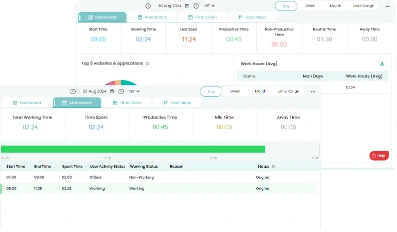
- Timeline View: A color-coded, hour-by-hour picture of the day showing productive, away, and working time. During a trial period, this is evidence rather than assertion.
- Automatic Time Capture: Hours recorded without manual entry, so your Friday summary is not you reconstructing the week from memory.
- Project and Task-level Time Allocation: Shows which work consumed the week, which is what turns "I was busy" into something a manager can actually read.
- Real-time Attendance Dashboard: Present, absent, and on leave at a glance, so nobody has to check whether you are around.
- Work-life Balance Overview: Focus time, breaks, and over-utilization in one view, with alerts for over-utilization, which matters because remote workers tend to overwork, not underwork.
On privacy, which is a fair thing to ask about: employees can see their own time tracking data, screenshot blur protects sensitive information, role-based access controls determine who can view records, and keystroke activity is measured as intensity rather than content. If your employer is going to have visibility either way, transparent and shared beats vague and assumed, and it is a reasonable thing to ask for as part of your proposal rather than something done to you.
Get real-time visibility into your remote team operations!
Time Champ gives you accurate insights to drive better remote decisions
A Few Final Words
Asking to work from home goes better when you stop asking for permission and start proposing an arrangement. Know what already exists at your company, decide exactly what you want, frame it around what your employer gains, put it on one page, ask live, answer the visibility question before it is raised, and offer a trial with an end date.
And if the answer is no, get to the actual reason before backing off, offer a smaller version, and set a date to revisit the conversation. Most work-from-home arrangements that exist today started as a thirty-day trial somebody was willing to structure properly.

Shabana Shaik

Table of Content
 How to Ask for Work from Home?
- Know What You Are Walking Into
- What Your Manager Is Actually Worried About
- 8 Steps to Ask for Work From Home
- Work From Home Request Email Templates
- What to Do If Your Request Is Denied
- How Time Champ Helps You Make the Case
- A Few Final Words
Related Blogs

Boost remote team productivity with practical management tips, proven best practices, key metrics, and tools that help your remote teams perform better.
Anjali | Jul 16, 2026
What does fully remote work mean? A clear definition, how it differs from hybrid, honest pros and cons, and practical tips to make working remotely work.
Shabana Shaik | Aug 17, 2026
Learn how to track time for remote workers using simple methods and remote tracking tools and learn best practices that improve trust and productivity.
Guna Lakshmi | May 19, 2026
Struggling with remote work productivity challenges? Learn what’s slowing your team down and how to improve focus, communication, and performance.
Guna Lakshmi | Apr 15, 2026
Learn the best remote employee engagement strategies for 2026 to boost productivity, retain top talent, build stronger teams, and measure long-term impact.
Jahnavi Pulluri | Aug 20, 2026
Manage your remote team across different time zones effectively with these tips on communication, collaboration, and flexibility.
Sai Keerthi Uppala | May 30, 2023


 4.7/5 avg.
Ready to Manage Your Workforce Smarter?
Join our family of 1500+ companies using smart insights to redefine workforces!

Free Trial
No Credit Card Required