Task Timer: Everything You Need to Know
Learn how a task timer boosts productivity, simplifies billing, and helps you manage time effectively. Learn its benefits and tips to tackle challenges!
Do you ever feel like time is slipping through your fingers when juggling multiple
tasks?
Oh, we understand – it can be quite difficult to keep track of everything without task timer.
Right?
Well, that is where our Task Timer comes in. It is like your personal time manager who helps to
track tasks, keeps on schedule, and ensures that you are billing accurately.
In this guide, you will learn how
to get the most out of this versatile tool, from your first-timer to easy invoicing.
Let’s dive right in and
begin! Switching to task timer apps early reduces the friction of moving to a full tracking platform later.
What is a Task Timer?
A task timer is a digital tool that helps to track how long employees spend on a task. It helps in time management by providing clear details about the time they have spent on different tasks. They can be physical devices, software applications, or built-in features in productivity tools.
Perks of Using a Task Timer
Using a task timer brings in many benefits for your organization some of them are:
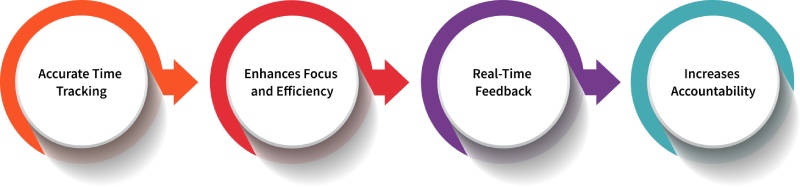
Accurate Time Tracking
A task timer provides the exact time taken to complete each task. This accuracy is necessary to get a better understanding of time management behaviors. Instead of having a guess or estimating how long it took to complete a specific task, you have a record of time. It helps you identify which tasks consume most of your employee’s time and whether to reduce the time spent on them. This way, you can also review the data and figure out what needs to be changed to increase productivity.
Enhances Focus and Efficiency
By using a timer for tasks, employees are always aware of the time passing, which helps them to concentrate on the task at hand. This awareness can reduce distractions and delays, as it prompts them to stay focused and efficient. Knowing that they are racing against time can boost productivity, enabling them to accomplish more in the same amount of time.
Real-Time Feedback
A task timer provides information on how staff are utilizing time on various tasks. This real-time information helps in monitoring the progress and changing the strategies in the process.
If you find out that they have taken more time on a certain task than you expected, you can adjust the behavior, work faster, or change their approach. This immediate feedback loop helps them to stay on target with their goals and deadlines, allowing them to make necessary adjustments.
Increases Accountability
A task time tracker improves accountability by recording the time staff spend on tasks. This transparency allows to take responsibility for work patterns and time management. When you look at the time logs, you can see how much work has been done and where they are lacking. This self-awareness helps in maintaining the planned work time and also assists in keeping them on track with their goal and timelines.
Also Read: How Using a Task Timer can Benefit your Organization
How to Use a Task Timer?
Using a task timer is simpler than you think. If you are new to time management tools or looking forward
to optimize your organization’s workflow, getting started with Time Champ’s task timer for tasks is straightforward.
Here are the detailed steps to help you effectively start and manage tasks:
Step 1: Start the Timer
To begin the timer, add a short description of the task that you want to work on, which
helps in tracking the work. After entering a description, all they have to do is click the “Run” button to start the
timer.
Tip: If employees are short on time, they can start the timer immediately and come back later to
add the description of the task.
Step 2: Manage Time Entries
Our task timer allows you to modify previous entries to accurately reflect the time
spent on the tasks. To better organize the work, use work tags and assign them to the work. These tags help to sort
and manage tasks properly.
Tip: You can set a task as billable or non-billable, and associate tasks with
projects for better organization.
Step 3: Monitor the Work Progress
It is important to keep track of employee’s progress to keep up the pace. You can
always monitor the tracked times on a daily, weekly or custom date range that you want. While doing this review, try
to identify which tasks they have put as billable and non-billable. It is also necessary to check the recorded
activities to ensure that all the activities are well recorded.
Tip: To get a better understanding of
the day, view all the recorded hours and tasks on a timeline.
Step 4: Timesheets
Time Champ generates timesheets automatically. Once timesheets are submitted, they can
be reviewed for accuracy and completeness. This step is important to make sure that work hours are recorded properly
and documented.
Once the timesheet is approved, it generates invoices, making the billing process easier, more
accurate, and efficient.
Step 5: Streamline Billing
Reducing administrative work is crucial and can be achieved through efficient management of billing processes. By effectively handling all billing-related activities for tasks and projects, it ensures that invoices are issued correctly and on time. This approach minimizes mistakes and saves significant time that would otherwise be spent on paperwork.
Challenges and Solutions in Using a Task Timer
Yes! There will be some challenges when using an online task timer.
Here are the
major challenges along with solutions to make tasks more efficient:
Challenge 1: One of the main issues with conventional online task timers is that
it is difficult to estimate the time required for a particular task. When there is no historical data, it is
impossible to estimate the time required, which can lead to setting unrealistic goals, and potentially cause a
project’s failure.
Solution: Time Champ’s comprehensive Work
Log Reports gives how long similar tasks have taken in the past. Using this historical data, you can make
more accurate estimates for future tasks. This is useful for viewing patterns in time usage and can be useful to
adjust the planning and avoid over-commitment to the deadlines.
Challenge 2: Regular task timers do not consider interruptions, and this hinders
time estimation and concentration.
Solution: Our Manual Logs & Bulk Edits action allows to
adjust time entries when interruptions occur, thus keeping records as accurate as possible. This helps to stay on
track and get things done despite constant interruptions.
Challenge 3: Setting several timers for various activities becomes confusing and
disorganized, which is counterproductive. Managing different timers can interfere with productivity and create
confusion about how much time has left.
Solution: Our task timer makes this easier by allowing you to
Pin Your Favorite Tasks. It allows you to have all your tasks in one place and easily manage them from the
same interface. This way, you can easily access the most frequently used tasks and start or stop timers without
switching between different interfaces. This helps to avoid confusion, organize the work, and make sure that you
spend more time on work rather than on the timers.
Challenge 4: Conventional online task timers include technical hitches that may
disrupt the working schedule. Problems like app crashes or data loss can be annoying and inconvenient.
Solution: Our task time tracker aims to avoid interferences and hindrances such as application freezing
or any other disturbances. You can track your tasks effectively, which means that you will be able to work without
having to worry about technical hitches.
Final Thoughts
In conclusion, a task timer is a very useful tool in time management, which increases the efficiency and accuracy in billing. Regardless of whether you decide to track tasks manually, with the help of Excel, or using digital software, the right timer for tasks can help avoid potential problems. Adopt the use of a task timer to manage time, enhance productivity and accomplish your objectives in the best possible way.
Boost your productivity with Time Champ’s Task Timer!
Start tracking now and manage tasks effortlessly. Try it today!

Jahnavi Pulluri

Table of Content
-
 What is a Task Timer?
-
Perks of Using a Task Timer
-
How to Use a Task Timer?
-
Challenges and Solutions in Using a Task Timer
-
Final Thoughts
Related Blogs

Struggling with employee shift scheduling? Explore the best types, benefits, and strategies to streamline shifts, boost productivity, and keep your
Tarun Kumar | 13 March 2025
Learn the benefits of a work time tracker, from boosting productivity to improving accuracy and streamlining workflow for better efficiency.
Thasleem Shaik | 13 March 2025
Get free attorney time tracking templates in Excel, PDF, and Word to streamline billing, improve accuracy, and manage billable hours
Thasleem Shaik | 12 March 2025
Toxic productivity at the workplace harms employee well-being and leads to burnout. Discover what it is, signs to watch for,
Sai Keerthi Uppala | 10 January 2025
Learn how to track time for remote workers with the best tools, methods, and practices to boost productivity and accountability.
Thasleem Shaik | 8 November 2024
Explore how Time Sheet Automation Professional Services can transform your operations with seamless time tracking and customized reporting solutions.
Jahnavi Pulluri | 8 November 2024


 4.7/5 avg.
Ready to Manage Your Workforce Smarter?
Join our family of 1500+ companies using smart insights to redefine workforces!

Free Trial
No Credit Card Required